
Installation
Built by people who play.
Delivery does not end when the container arrives. Our crews assemble every court to international standards of safety and play, check each step and hand it over ready for the first match.

Short answer
How long does it take to install a padel court?
About four days per court on a ready, level concrete slab: around three days for the structure, glass and lighting and one day for the turf. Prism crews (a structure team of 4–6 and a turf team of 4–5) install, check every step and train your staff. From signed order to first serve, most projects take 8–12 weeks.
On site
Four days, court by court.
On a ready, level concrete slab our crews build one court in about four days.
Day 1 · Set out
Check the slab, mark the court and anchor the base of the frame.
Day 2 · Structure
Frame, posts and mesh panels go up, aligned to the millimetre.
Day 3 · Glass and light
Glass panels fixed with silicone joints, lights and poles mounted.
Day 4 · Turf
Turf laid, seams bonded, lines set, sand spread and brushed in.
Handover
Play test, quality check and staff training on care.
The turf finish
Invisible seams. Even bounce.
What separates an average court from a premium one is how the turf is cut, joined and filled. Our crews follow the same nine steps on every court.
- STEP 1
Base check
A level, clean slab prevents wrinkles and bumps later.
- STEP 2
Shock pad
Where specified, an even pad under the turf for comfort.
- STEP 3
Marking
Lines and roll positions set out before any cut.
- STEP 4
Unrolling and settling
Rolls laid out to relax, so they do not shrink later.
- STEP 5
Precise cuts and seams
Seams placed where players and cameras see them least.
- STEP 6
Bonding
Joint tape, adhesive at even thickness, turf pressed down.
- STEP 7
Silica sand
Rounded sand brushed in for grip, slide and bounce.
- STEP 8
Brushing and trim
Fibres lifted, edges trimmed clean.
- STEP 9
Quality check and play test
We play the court before we sign it off.
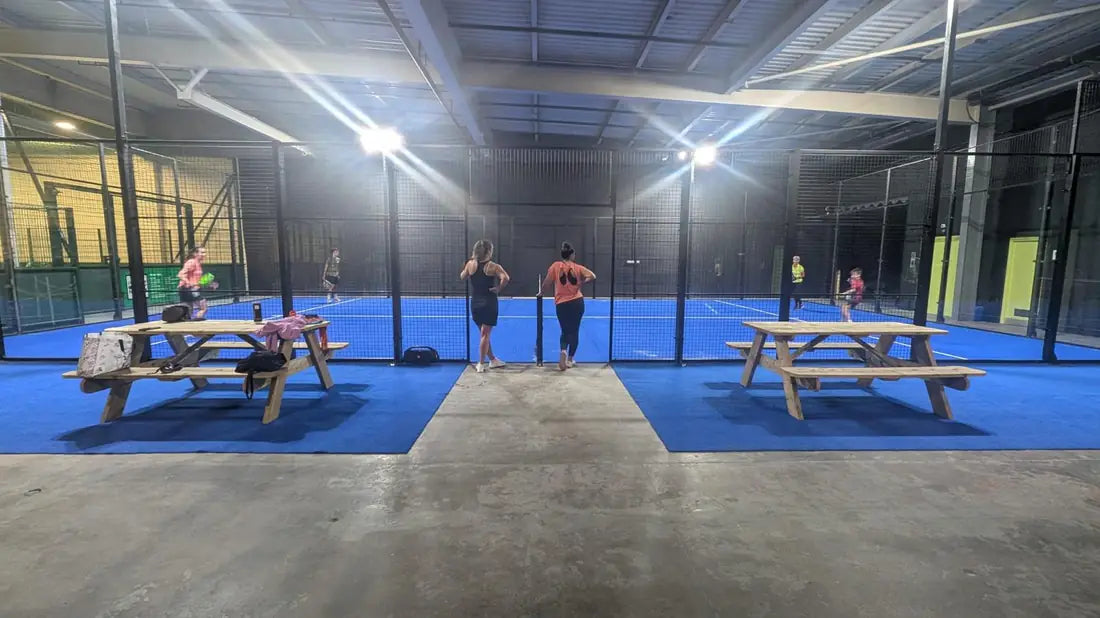
Our crews
Supervised, trained, accountable.
Every installation is carried out or supervised by trained technicians. In markets with many courts we train and certify local teams, which lowers travel costs and gives you a crew nearby for maintenance later.
- Expert supervision on every project
- Local teams trained and certified by us
- Quality checks at structure, glass, turf and lighting
- Monthly or quarterly maintenance by the same team
What you prepare
Ready for day one.
We send drawings and a checklist well before delivery, so the site is ready when the crew arrives.
Concrete slab
About 260 m² per court incl. run-off, 15 cm thick, level, with a slight drainage fall.
Access and unloading
Truck access to the site and a forklift or crane to unload the container.
Power
An electrical supply to the court for the lighting, by your electrician.
Permits
Local building and lighting permits, with drawings from us.
Storage
A dry, secure place for glass and turf until they are installed.
A contact on site
One person who can make decisions during the build.
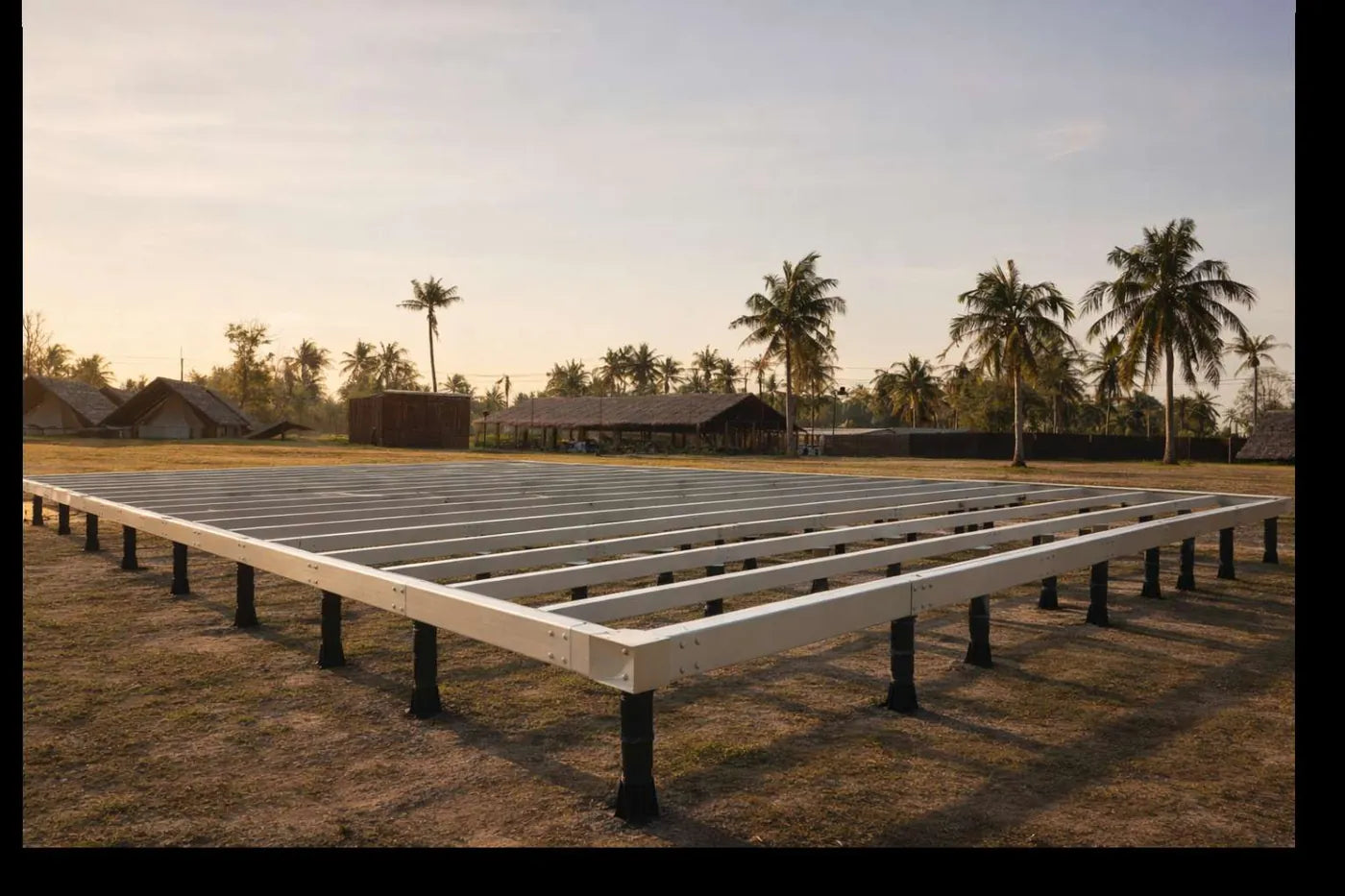
No slab? No problem
The raised platform base.
On slopes, rooftops, lawns or rented land, a Prism Pano court can stand on a modular steel platform instead of a concrete slab. Adjustable legs level out slopes of up to 1 m, and the court can be moved later.
- No concrete foundation, little or no groundwork
- Adjustable legs for slopes up to 1 m
- Concrete-tile deck for a true bounce
- Fully removable and relocatable
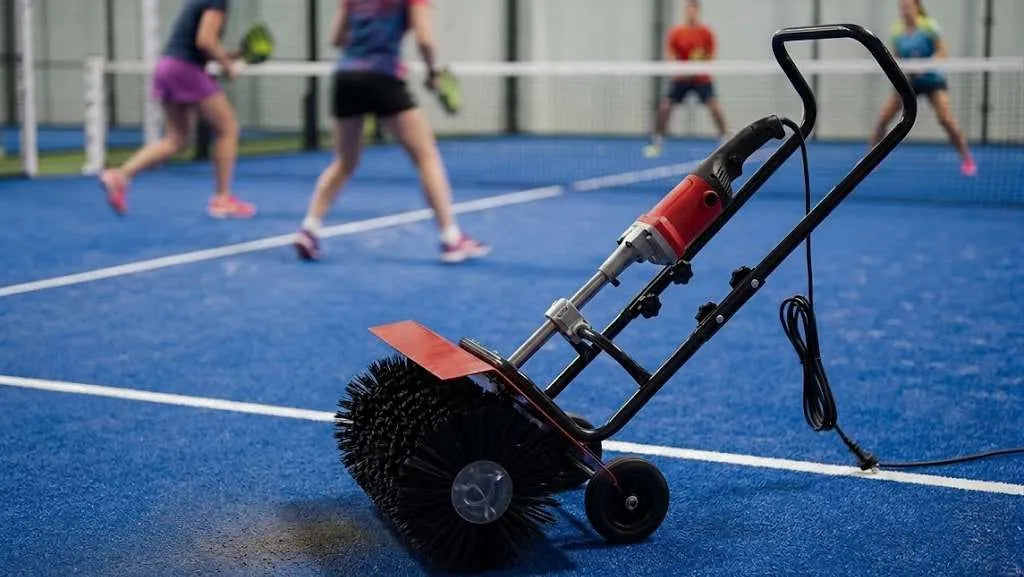
Aftercare
We stay after the last screw.
Your court comes with spare parts, a maintenance plan and a team that answers. We help with troubleshooting, replacements and upgrades, so your courts stay booked.
- Spare glass panels, screws and supports included
- Staff training on daily and weekly care
- Brushing machines, sand spreaders and ball pickers available
- 3-year structural and up to 5-year lighting warranty
Installation included in your price.
The court builder includes installation per court, so the price you see is for a finished, playable court.
FAQ
Installation questions.
Still unsure? WhatsApp +46 73 509 69 60 for an answer the same day.
How long does it take to install a padel court?
About four days per court on a ready slab: three days for structure, glass and lighting, and one day for turf. Several courts are built in parallel or in sequence.
Is installation included in the price?
Yes. Prism prices include installation by our crews. The concrete slab, unloading, electrical connection and permits are arranged by you.
What base does a padel court need?
A level reinforced concrete slab of about 15 cm, around 260 m² per court including run-off, with a slight fall for drainage. Or a raised platform base where a slab is not possible.
Do you install padel courts worldwide?
Yes. Our crews have built courts in Asia, Europe, Africa and the Middle East, and we train local teams in growing markets.
What maintenance does a padel court need?
Regular brushing and topping up of sand, checking net tension and fixings, and cleaning glass. We train your staff and can offer scheduled maintenance.
What warranty do I get?
A 3-year structural warranty and up to 5 years on lighting. Spare glass panels are included because glass breakage is not covered by any supplier.
Let’s build your court.
Tell us about your site. You get a layout, a timeline and an itemised quote, usually within 48 hours.
info@prismpadel.com
+46 73 509 69 60
Bangkok · Hong Kong · Stockholm · Oslo